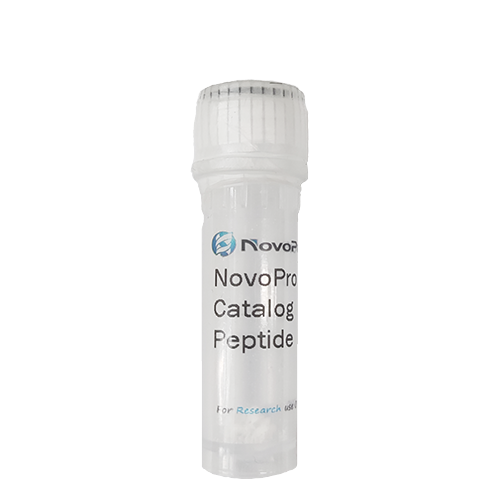
Miraculin (1-20) peptide
Not For Human Use, Lab Use Only.
Cat.#: 311434
Special Price 253.00 USD
Availability:
5 working days
-
Product Name
Miraculin (1-20) peptide
-
Documents
Batch to batch variation of the purity
-
Sequence Shortening
DSAPNPVLDIDGEKLRTGTN
-
Sequence
H-Asp-Ser-Ala-Pro-Asn-Pro-Val-Leu-Asp-Ile-Asp-Gly-Glu-Lys-Leu-Arg-Thr-Gly-Thr-Asn-OH
-
Length (aa)
20
-
Peptide Purity (HPLC)
96.5%
-
Molecular Formula
C88H146N26O34
-
Molecular Weight
2112.28
-
Source
Synthetic
-
Form
Powder
-
Description
Miraculin is a taste-modifying protein isolated from the berries of the West African shrub Synsepalum dulcificum. In sensory studies, application of miraculin to the tongue alters gustatory responses, notably enhancing the neural response to acidic stimuli while moderately depressing the response to sweet stimuli in certain taste fibers. Electrophysiological recordings from the chorda tympani nerve demonstrate that this protein induces a prolonged increase in nerve activity upon acid stimulation, an effect correlated with behavioral shifts in preference. The action of miraculin is particularly evident in taste fibers that normally exhibit high sensitivity to a broad spectrum of sweet-tasting compounds.
The protein's effect is thought to involve interaction with structures in taste cell membranes associated with sweet taste perception, rendering them responsive to hydrogen ions. This modification leads to a distinct change in the quality of the gustatory signal conveyed by specific afferent taste fibers. Research indicates that the identity of the activated neural pathway, rather than temporal patterning within individual fibers, is critical for this perceived taste quality alteration.
-
Storage Guidelines
Normally, this peptide will be delivered in lyophilized form and should be stored in a freezer at or below -20 °C. For more details, please refer to the manual: Handling and Storage of Synthetic Peptides
-
References
- S.Theerasilp and Y.Kurihara, J. Biol. Chem., 263, 11536 (1988)
- Brouwer JN, Glaser D, Hard Af Segerstad C, Hellekant G, Ninomiya Y, Van der Wel H. The sweetness-inducing effect of miraculin; behavioural and neurophysiological experiments in the rhesus monkey Macaca mulatta. J Physiol. 1983 Apr;337:221-40. doi: 10.1113/jphysiol.1983.sp014621. PMID: 6875928; PMCID: PMC1199104.
-
About TFA salt
Trifluoroacetic acid (TFA) is a common counterion from the purification process using High-Performance Liquid Chromatography (HPLC). The presence of TFA can affect the peptide's net weight, appearance, and solubility.
Impact on Net Weight: The TFA salt contributes to the total mass of the product. In most cases, the peptide content constitutes >80% of the total weight, with TFA accounting for the remainder.
Solubility: TFA salts generally enhance the solubility of peptides in aqueous solutions.
In Biological Assays: For most standard in vitro assays, the residual TFA levels do not cause interference. However, for highly sensitive cellular or biochemical studies, please be aware of its presence.
-
Molar Concentration Calculator
-
Dilution Calculator
-
Percent Concentration Calculator
Mass (g) = Concentration (mol/L) × Volume (L) × Molecular Weight (g/mol)
Related Products / Services
• Peptide Services: NovoPro's peptide synthesis services include standard chemical peptide synthesis, peptide modification, peptide libraries, and recombinant peptide expression.
• Standard Peptide Synthesis: NovoPro offers quality peptides at the most competitive prices in the industry, starting at $3.20 per amino acid. NovoPro provides PepBox – Automatic Quote Tool for online price calculation.
• Peptide Modifications: NovoPro offers a wide range of peptide modification services including isotope labeling (2H, 15N, and 13C), multiple disulfide bonds, multiple phosphorylations, KLH, BSA, ovalbumin, amidation, acetylation, biotin, FITC, etc.
Please note: All products are "FOR RESEARCH USE ONLY AND ARE NOT INTENDED FOR DIAGNOSTIC OR THERAPEUTIC USE"