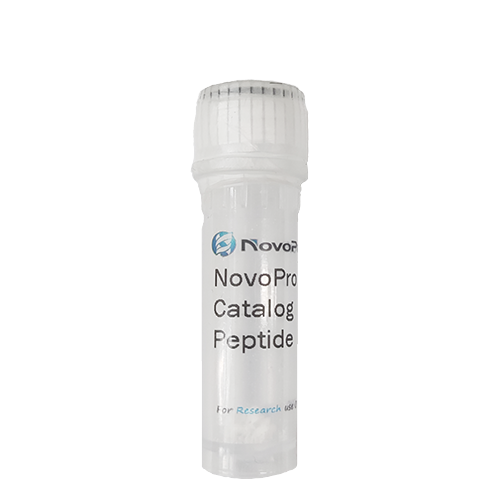
Angiotensin (1-5) peptide
Not For Human Use, Lab Use Only.
Cat.#: 308138
Special Price 121.40 USD
Availability:
5 working days
-
Product Name
Angiotensin (1-5) peptide
-
Documents
Batch to batch variation of the purity
-
Sequence Shortening
DRVYI
-
Sequence
Asp-Arg-Val-Tyr-Ile
-
Length (aa)
5
-
Peptide Purity (HPLC)
99.2%
-
Molecular Formula
C30H48N8O9
-
Molecular Weight
664.75
-
CAS No.
58442-64-1
-
Source
Synthetic
-
Form
Powder
-
Description
Angiotensin (1-5) is a peptide fragment derived from the enzymatic processing of angiotensin I. Angiotensin I, a decapeptide, is cleaved by the angiotensin-converting enzyme (ACE), a peptidyl dipeptide hydrolase, which removes a C-terminal histidyl-leucine dipeptide to form the octapeptide angiotensin II. This conversion is a key step in the renin-angiotensin system. The enzyme exhibits broad specificity, hydrolyzing peptide bonds in various substrates, and requires chloride ions as a cofactor for optimal activity with certain peptides. ACE is widely distributed, with high concentrations found on vascular endothelial surfaces, particularly in the lung, and in renal proximal tubule epithelial cells.
The formation of angiotensin (1-5) involves further proteolytic cleavage of angiotensin I or II. While the provided text focuses on the conversion to angiotensin II, related enzymatic pathways can yield shorter fragments like angiotensin (1-5). This peptide is part of a cascade where sequential enzymatic actions modulate bioactive peptide profiles. The converting enzyme itself is a zinc-metallopeptidase, often membrane-bound, and its activity influences the balance between vasoactive peptides in circulation and local tissues.
-
Storage Guidelines
Normally, this peptide will be delivered in lyophilized form and should be stored in a freezer at or below -20 °C. For more details, please refer to the manual: Handling and Storage of Synthetic Peptides
-
References
- Erdös EG. Conversion of angiotensin I to angiotensin II. Am J Med. 1976 May 31;60(6):749-59. doi: 10.1016/0002-9343(76)90889-5. PMID: 190881.
-
About TFA salt
Trifluoroacetic acid (TFA) is a common counterion from the purification process using High-Performance Liquid Chromatography (HPLC). The presence of TFA can affect the peptide's net weight, appearance, and solubility.
Impact on Net Weight: The TFA salt contributes to the total mass of the product. In most cases, the peptide content constitutes >80% of the total weight, with TFA accounting for the remainder.
Solubility: TFA salts generally enhance the solubility of peptides in aqueous solutions.
In Biological Assays: For most standard in vitro assays, the residual TFA levels do not cause interference. However, for highly sensitive cellular or biochemical studies, please be aware of its presence.
-
Molar Concentration Calculator
-
Dilution Calculator
-
Percent Concentration Calculator
Mass (g) = Concentration (mol/L) × Volume (L) × Molecular Weight (g/mol)
Related Products / Services
• Peptide Services: NovoPro's peptide synthesis services include standard chemical peptide synthesis, peptide modification, peptide libraries, and recombinant peptide expression.
• Standard Peptide Synthesis: NovoPro offers quality peptides at the most competitive prices in the industry, starting at $3.20 per amino acid. NovoPro provides PepBox – Automatic Quote Tool for online price calculation.
• Peptide Modifications: NovoPro offers a wide range of peptide modification services including isotope labeling (2H, 15N, and 13C), multiple disulfide bonds, multiple phosphorylations, KLH, BSA, ovalbumin, amidation, acetylation, biotin, FITC, etc.
Please note: All products are "FOR RESEARCH USE ONLY AND ARE NOT INTENDED FOR DIAGNOSTIC OR THERAPEUTIC USE"