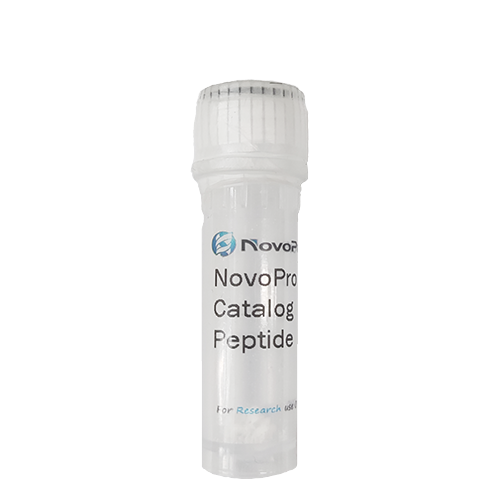
Andersonin-W1 peptide
Not For Human Use, Lab Use Only.
Cat.#: 311039
Special Price 325.00 USD
Availability:
1-2 weeks
-
Product Name
Andersonin-W1 peptide
-
Documents
Batch to batch variation of the purity
-
Sequence Shortening
ATNIPFKVHFRCKAAFC
-
Sequence
Ala-Thr-Asn-Ile-Pro-Phe-Lys-Val-His-Phe-Arg-Cys-Lys-Ala-Ala-Phe-Cys
-
Length (aa)
17
-
Peptide Purity (HPLC)
97.4%
-
Source
Synthetic
-
Form
Powder
-
Description
Andersonin-W1 (AW1) is a bioactive peptide originally identified from the amphibian Oreochromis andersonii. Its mature form is a short peptide composed of 17 amino acid residues with the sequence ATNIPFKVHFRCKAAFC. In vitro studies demonstrate that AW1, at nanomolar concentrations, can promote the proliferation and migration of keratinocytes, enhance macrophage proliferation, and stimulate tube formation in human umbilical vein endothelial cells (HUVECs), indicating activities related to cellular processes involved in tissue repair.
Mechanistically, AW1 directly interacts with the extracellular domain of Toll-like receptor 4 (TLR4) on macrophages. This binding event modulates the downstream nuclear factor-kappa B (NF-κB) signaling pathway. This interaction allows AW1 to regulate macrophage polarization and the secretion of inflammatory cytokines, thereby influencing the inflammatory phase of tissue response. The peptide's ability to engage with the TLR4/NF-κB axis highlights its role as a molecular probe for studying immunomodulatory pathways.
-
Storage Guidelines
Normally, this peptide will be delivered in lyophilized form and should be stored in a freezer at or below -20 °C. For more details, please refer to the manual: Handling and Storage of Synthetic Peptides
-
References
- Yang X, Lee WH, Zhang Y. Extremely abundant antimicrobial peptides existed in the skins of nine kinds of Chinese odorous frogs. J Proteome Res. 2012;11(1):306-19.
- Li C, Xiong Y, Fu Z, Ji Y, Yan J, Kong Y, Peng Y, Ru Z, Huang Y, Li Y, Yang Y, He L, Tang J, Wang Y, Yang X. The direct binding of bioactive peptide Andersonin-W1 to TLR4 expedites the healing of diabetic skin wounds. Cell Mol Biol Lett. 2024 Feb 5;29(1):24. doi: 10.1186/s11658-024-00542-4. Erratum in: Cell Mol Biol Lett. 2026 Feb 18;31(1):25. doi: 10.1186/s11658-026-00878-z. PMID: 38317065; PMCID: PMC10845795.
-
About TFA salt
Trifluoroacetic acid (TFA) is a common counterion from the purification process using High-Performance Liquid Chromatography (HPLC). The presence of TFA can affect the peptide's net weight, appearance, and solubility.
Impact on Net Weight: The TFA salt contributes to the total mass of the product. In most cases, the peptide content constitutes >80% of the total weight, with TFA accounting for the remainder.
Solubility: TFA salts generally enhance the solubility of peptides in aqueous solutions.
In Biological Assays: For most standard in vitro assays, the residual TFA levels do not cause interference. However, for highly sensitive cellular or biochemical studies, please be aware of its presence.
-
Molar Concentration Calculator
-
Dilution Calculator
-
Percent Concentration Calculator
Mass (g) = Concentration (mol/L) × Volume (L) × Molecular Weight (g/mol)
Related Products / Services
• Peptide Services: NovoPro's peptide synthesis services include standard chemical peptide synthesis, peptide modification, peptide libraries, and recombinant peptide expression.
• Standard Peptide Synthesis: NovoPro offers quality peptides at the most competitive prices in the industry, starting at $3.20 per amino acid. NovoPro provides PepBox – Automatic Quote Tool for online price calculation.
• Peptide Modifications: NovoPro offers a wide range of peptide modification services including isotope labeling (2H, 15N, and 13C), multiple disulfide bonds, multiple phosphorylations, KLH, BSA, ovalbumin, amidation, acetylation, biotin, FITC, etc.
Please note: All products are "FOR RESEARCH USE ONLY AND ARE NOT INTENDED FOR DIAGNOSTIC OR THERAPEUTIC USE"