-
Product Name
Recombinant RBM20 protein (His tag)
- Documents
-
Description
Recombinant Human RBM20 (517-625) Fragment: A high-purity, functional protein fragment encompassing the RNA Recognition Motif (RRM) domain of RNA-binding protein 20. This product is an essential tool for investigating the molecular mechanisms of alternative splicing regulation, particularly in cardiac and skeletal muscle development.
RNA-binding protein 20 (RBM20) is a critical regulator of mRNA splicing for genes encoding key structural proteins involved in cardiac development, such as TTN (Titin), CACNA1C, and CAMK2D. It functions as a splicing repressor by binding the 5'UCUU-3' motif in pre-mRNAs, leading to exon exclusion in target transcripts. RBM20-mediated exon skipping is hormone-dependent and vital for TTN isoform transition in muscle tissues, and it also facilitates the formation of circular RNAs from TTN transcripts. The protein localizes primarily to the nucleus in its active form, where it regulates alternative splicing, but it also resides in cytoplasmic ribonucleoprotein granules, with its subcellular distribution modulated by phosphorylation. The provided recombinant fragment (517-625) contains the RRM domain, enabling focused studies on RNA-binding specificity and splicing regulatory functions.
-
Protein name
RNA-binding protein 20
-
Uniprot ID
Q5T481
-
Gene Name
RBM20
-
Source/Expression Host
E. coli
-
Expression Plasmid/cDNA
DNA encoding 517-625 aa (Q5T481) were fused with C-terminal 6His tag.
-
Sequence
MGRVVHICNL PEGSCTENDV INLGLPFGKV TNYILMKSTN QAFLEMAYTE AAQAMVQYYQ EKSAVINGEK LLIRMSKRYK
ELQLKKPGKA VAAIIQDIHS QRERDMFREA LEHHHHHH
-
Protein Species
Human
-
Molecular weight
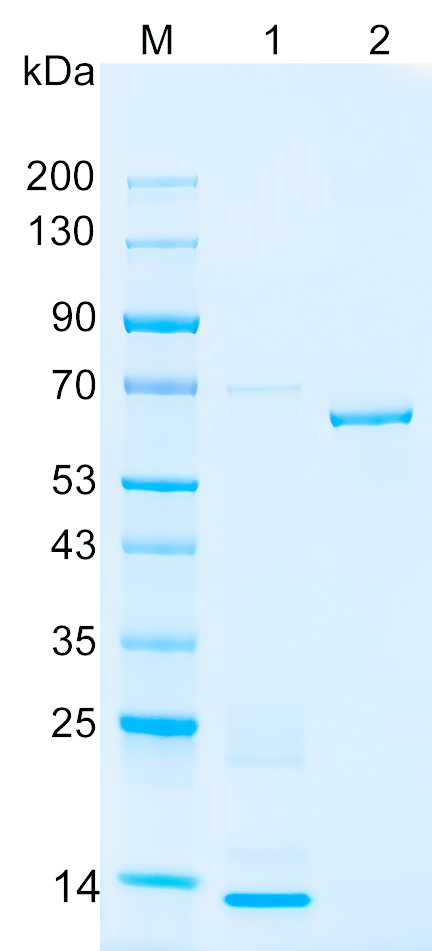
Predictes a molecular mass of 13.57 kDa. In SDS-PAGE under reducing conditions, it migrates as an approximately 14 kDa band.
-
Purity
>85%, by SDS-PAGE with Coomassie Brilliant Blue staining.
-
Activity
Not tested.
-
Validations
Recombinant RBM20 protein (His tag)
M: Marker; Lane 1: RBM20; Lane 2: BSA
Related Products / Services
Please note: All products are "FOR RESEARCH USE ONLY AND ARE NOT INTENDED FOR DIAGNOSTIC OR THERAPEUTIC USE"