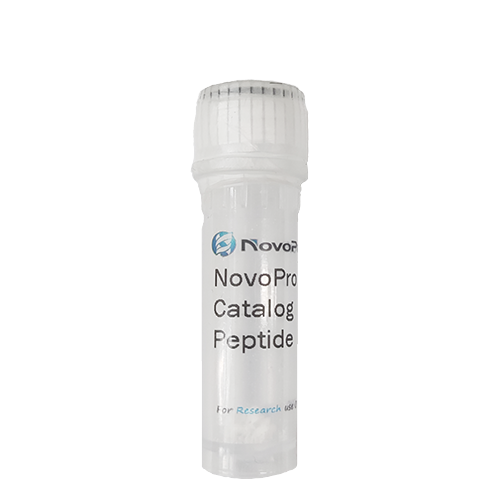
Phylloseptin-L2 peptide
Not For Human Use, Lab Use Only.
Cat.#: 313601
Special Price 189.80 USD
Availability:
5 working days
-
Product Name
Phylloseptin-L2 peptide
-
Documents
Batch to batch variation of the purity
-
Sequence Shortening
FLSLIPHVISALSSL-NH2
-
Sequence
H-Phe-Leu-Ser-Leu-Ile-Pro-His-Val-Ile-Ser-Ala-Leu-Ser-Ser-Leu-NH2
-
Length (aa)
15
-
Peptide Purity (HPLC)
96.87%
-
Molecular Formula
C76H126N18O19
-
Molecular Weight
1595.92
-
Source
Synthetic
-
Form
Powder
-
Description
Phylloseptin-L2 is a peptide belonging to the phylloseptin family, isolated from the skin secretions of the Lemur leaf frog Hylomantis lemur, a species within the Phyllomedusinae subfamily. Its primary structure, FLSLIPHVISALSSL, was determined through automated Edman degradation, and the peptide is C-terminally alpha-amidated. Phylloseptin-L2 exhibits the ability to stimulate insulin release from rat clonal BRIN-BD11 beta cells in a concentration-dependent manner, with a significant effect observed at 30 nM and a maximum response at 3 µM, without compromising plasma membrane integrity as indicated by the lack of lactate dehydrogenase release.
The peptide’s insulinotropic action appears to be independent of extracellular calcium influx and ATP-sensitive potassium channel closure, as activity is maintained in the absence of calcium and in the presence of verapamil and diazoxide. Phylloseptin-L2 has low cationicity, which is inversely related to its antimicrobial potency, suggesting a mechanism of action that involves traversing the plasma membrane without permeabilization. The peptide is structurally related to other phylloseptins found in Phyllomedusa species but lacks a basic residue, influencing its reduced antimicrobial activity while enhancing its insulin-releasing properties.
-
Storage Guidelines
Normally, this peptide will be delivered in lyophilized form and should be stored in a freezer at or below -20 °C. For more details, please refer to the manual: Handling and Storage of Synthetic Peptides
-
References
- Yasser H.A. Abdel-Wahab; Gavin J. Power; Peter R. Flatt; Douglas C. Woodhams; Louise A. Rollins-Smith; J. Michael Conlon. (2008). A peptide of the phylloseptin family from the skin of the frog Hylomantis lemur (Phyllomedusinae) with potent in vitro and in vivo insulin-releasing activity. 29(12), 0–2143.
-
About TFA salt
Trifluoroacetic acid (TFA) is a common counterion from the purification process using High-Performance Liquid Chromatography (HPLC). The presence of TFA can affect the peptide's net weight, appearance, and solubility.
Impact on Net Weight: The TFA salt contributes to the total mass of the product. In most cases, the peptide content constitutes >80% of the total weight, with TFA accounting for the remainder.
Solubility: TFA salts generally enhance the solubility of peptides in aqueous solutions.
In Biological Assays: For most standard in vitro assays, the residual TFA levels do not cause interference. However, for highly sensitive cellular or biochemical studies, please be aware of its presence.
-
Molar Concentration Calculator
-
Dilution Calculator
-
Percent Concentration Calculator
Mass (g) = Concentration (mol/L) × Volume (L) × Molecular Weight (g/mol)
Related Products / Services
• Peptide Services: NovoPro's peptide synthesis services include standard chemical peptide synthesis, peptide modification, peptide libraries, and recombinant peptide expression.
• Standard Peptide Synthesis: NovoPro offers quality peptides at the most competitive prices in the industry, starting at $3.20 per amino acid. NovoPro provides PepBox – Automatic Quote Tool for online price calculation.
• Peptide Modifications: NovoPro offers a wide range of peptide modification services including isotope labeling (2H, 15N, and 13C), multiple disulfide bonds, multiple phosphorylations, KLH, BSA, ovalbumin, amidation, acetylation, biotin, FITC, etc.
Please note: All products are "FOR RESEARCH USE ONLY AND ARE NOT INTENDED FOR DIAGNOSTIC OR THERAPEUTIC USE"