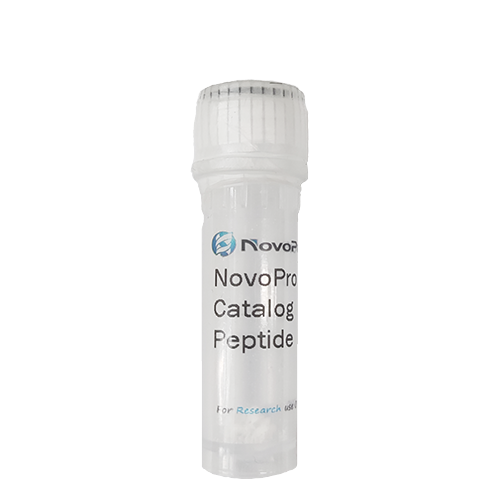
LAH4 peptide
Not For Human Use, Lab Use Only.
Cat.#: 319804
Special Price 286.20 USD
Availability:
5 working days
-
Product Name
LAH4 peptide
-
Documents
Batch to batch variation of the purity
-
Sequence Shortening
H-KKALLALALHHLAHLALHLALALKKA-OH
-
Sequence
H-Lys-Lys-Ala-Leu-Leu-Ala-Leu-Ala-Leu-His-His-Leu-Ala-His-Leu-Ala-Leu-His-Leu-Ala-Leu-Ala-Leu-Lys-Lys-Ala-OH
-
Length (aa)
26
-
Peptide Purity (HPLC)
95.98%
-
Molecular Formula
C132H228N38O27
-
Molecular Weight
2779.46
-
CAS No.
184776-51-0
-
PubChem CID
498149969
-
Source
Synthetic
-
Form
Powder
-
Description
LAH4 is a 26-amino-acid cationic amphipathic α-helical peptide (sequence: KKALLALALHHLAHLALHLALALKKA), carrying a net charge of +5 at neutral pH thanks to 5 lysines and 4 histidines. It has a hydrophobic moment of 1.35 and average hydrophobicity of 1.28, and can bind nucleic acids spontaneously.
Its conformation changes with pH: at pH 7.5, terminal lysines anchor it across lipid bilayers as a transmembrane helix; in acidic environments, histidine imidazole groups get protonated, flipping LAH4 to lie flat on the membrane surface. Solid-state NMR confirms LAH4 preferentially binds and disturbs the acyl chains of anionic lipids (PS, PG), barely affecting neutral phosphatidylcholine (PC), and this lipid-disrupting effect intensifies under acid conditions.
The peptide’s membrane-damaging potency is controlled by the spatial angle of positively charged histidines: variants with 80° or 100° histidine angles break anionic lipid structures most effectively, while 60° and 180° variants work poorly.
Multiple modified LAH4 derivatives (LAH4-L1, LAH4-L1-R, LAH4-Leu, LAH4-L1-Leu, LAH4-L1-F) are created via amino acid substitutions. These changes adjust peptide hydrophobicity and hydrophobic moment, tuning their binding to nucleic acids and cell membranes, and all LAH4-type peptides break endosomal membranes in a pH-responsive way to deliver nucleic acids into cells.
-
Storage Guidelines
Normally, this peptide will be delivered in lyophilized form and should be stored in a freezer at or below -20 °C. For more details, please refer to the manual: Handling and Storage of Synthetic Peptides
-
References
- Mason AJ, Martinez A, Glaubitz C, Danos O, Kichler A, Bechinger B. The antibiotic and DNA-transfecting peptide LAH4 selectively associates with, and disorders, anionic lipids in mixed membranes. FASEB J. 2006 Feb;20(2):320-2. doi: 10.1096/fj.05-4293fje. Epub 2005 Dec 13. PMID: 16352649.
- Langlet-Bertin B, Leborgne C, Scherman D, Bechinger B, Mason AJ, Kichler A. Design and evaluation of histidine-rich amphipathic peptides for siRNA delivery. Pharm Res. 2010 Jul;27(7):1426-36. doi: 10.1007/s11095-010-0138-2. PMID: 20393870.
-
About TFA salt
Trifluoroacetic acid (TFA) is a common counterion from the purification process using High-Performance Liquid Chromatography (HPLC). The presence of TFA can affect the peptide's net weight, appearance, and solubility.
Impact on Net Weight: The TFA salt contributes to the total mass of the product. In most cases, the peptide content constitutes >80% of the total weight, with TFA accounting for the remainder.
Solubility: TFA salts generally enhance the solubility of peptides in aqueous solutions.
In Biological Assays: For most standard in vitro assays, the residual TFA levels do not cause interference. However, for highly sensitive cellular or biochemical studies, please be aware of its presence.
-
Molar Concentration Calculator
-
Dilution Calculator
-
Percent Concentration Calculator
Mass (g) = Concentration (mol/L) × Volume (L) × Molecular Weight (g/mol)
Related Products / Services
• Peptide Services: NovoPro's peptide synthesis services include standard chemical peptide synthesis, peptide modification, peptide libraries, and recombinant peptide expression.
• Standard Peptide Synthesis: NovoPro offers quality peptides at the most competitive prices in the industry, starting at $3.20 per amino acid. NovoPro provides PepBox – Automatic Quote Tool for online price calculation.
• Peptide Modifications: NovoPro offers a wide range of peptide modification services including isotope labeling (2H, 15N, and 13C), multiple disulfide bonds, multiple phosphorylations, KLH, BSA, ovalbumin, amidation, acetylation, biotin, FITC, etc.
Please note: All products are "FOR RESEARCH USE ONLY AND ARE NOT INTENDED FOR DIAGNOSTIC OR THERAPEUTIC USE"