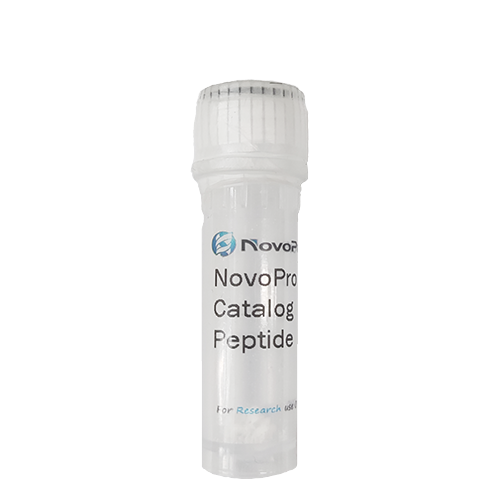
Histone H3 (1-35) peptide
Not For Human Use, Lab Use Only.
Cat.#: 319818
Special Price 649.00 USD
Availability:
4 weeks
-
Product Name
Histone H3 (1-35) peptide
-
Documents
Batch to batch variation of the purity
-
Sequence Shortening
H-ARTKQTARKSTGGKAPRKQLATKAARKSAPATGGV-OH
-
Sequence
H-Ala-Arg-Thr-Lys-Gln-Thr-Ala-Arg-Lys-Ser-Thr-Gly-Gly-Lys-Ala-Pro-Arg-Lys-Gln-Leu-Ala-Thr-Lys-Ala-Ala-Arg-Lys-Ser-Ala-Pro-Ala-Thr-Gly-Gly-Val-OH
-
Length (aa)
35
-
Peptide Purity (HPLC)
95.73%
-
Molecular Formula
C149H269N55O45
-
Molecular Weight
3551.05
-
Source
Synthetic
-
Form
Powder
-
Description
Histone H3 (1-35) is a peptide fragment derived from the N-terminal region of histone H3, one of the five major classes of nucleosomal core histones (H2A, H2B, H3, and H4). This highly conserved peptide plays a crucial role in chromatin structure and dynamics, characterized by its enrichment in basic residues such as arginine and lysine. The N-terminal tail of histone H3, including residues 1-35, is subject to various post-translational modifications that regulate DNA-histone interactions and chromatin remodeling processes.
The Histone H3 (1-35) fragment contributes to nucleosome assembly by participating in histone-DNA binding and stabilizing the chromatin fiber. Its sequence contains key modification sites, such as lysine residues, which can undergo acetylation, methylation, or phosphorylation, influencing transcriptional regulation and epigenetic signaling. Due to its conserved nature and functional significance, this peptide is widely studied in structural and biochemical investigations of chromatin organization.
-
Storage Guidelines
Normally, this peptide will be delivered in lyophilized form and should be stored in a freezer at or below -20 °C. For more details, please refer to the manual: Handling and Storage of Synthetic Peptides
-
References
- Bhasin M, Reinherz EL, Reche PA. Recognition and classification of histones using support vector machine. J Comput Biol. 2006 Jan-Feb;13(1):102-12. doi: 10.1089/cmb.2006.13.102. PMID: 16472024.
-
About TFA salt
Trifluoroacetic acid (TFA) is a common counterion from the purification process using High-Performance Liquid Chromatography (HPLC). The presence of TFA can affect the peptide's net weight, appearance, and solubility.
Impact on Net Weight: The TFA salt contributes to the total mass of the product. In most cases, the peptide content constitutes >80% of the total weight, with TFA accounting for the remainder.
Solubility: TFA salts generally enhance the solubility of peptides in aqueous solutions.
In Biological Assays: For most standard in vitro assays, the residual TFA levels do not cause interference. However, for highly sensitive cellular or biochemical studies, please be aware of its presence.
-
Molar Concentration Calculator
-
Dilution Calculator
-
Percent Concentration Calculator
Mass (g) = Concentration (mol/L) × Volume (L) × Molecular Weight (g/mol)
Related Products / Services
• Peptide Services: NovoPro's peptide synthesis services include standard chemical peptide synthesis, peptide modification, peptide libraries, and recombinant peptide expression.
• Standard Peptide Synthesis: NovoPro offers quality peptides at the most competitive prices in the industry, starting at $3.20 per amino acid. NovoPro provides PepBox – Automatic Quote Tool for online price calculation.
• Peptide Modifications: NovoPro offers a wide range of peptide modification services including isotope labeling (2H, 15N, and 13C), multiple disulfide bonds, multiple phosphorylations, KLH, BSA, ovalbumin, amidation, acetylation, biotin, FITC, etc.
Please note: All products are "FOR RESEARCH USE ONLY AND ARE NOT INTENDED FOR DIAGNOSTIC OR THERAPEUTIC USE"