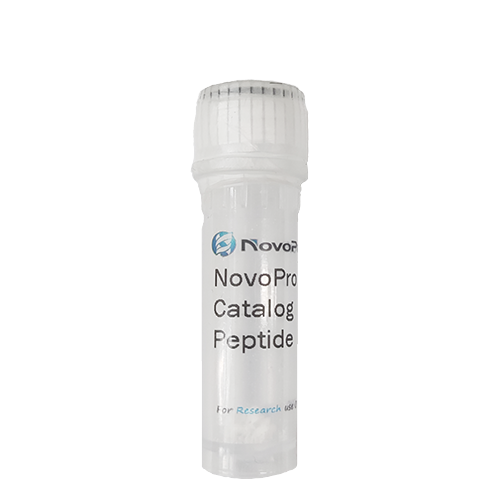
Gastric Inhibitory peptide (3-42) (human) / GIP (3-42), human
Not For Human Use, Lab Use Only.
Cat.#: 304043
Special Price 607.20 USD
Availability:
5 weeks
-
Product Name
Gastric Inhibitory peptide (3-42) (human) / GIP (3-42), human
-
Documents
Batch to batch variation of the purity
-
Sequence Shortening
EGTFISDYSIAMDKIHQQDFVNWLLAQKGKKNDWKHNITQ
-
Sequence
H-Glu-Gly-Thr-Phe-Ile-Ser-Asp-Tyr-Ser-Ile-Ala-Met-Asp-Lys-Ile-His-Gln-Gln-Asp-Phe-Val-Asn-Trp-Leu-Leu-Ala-Gln-Lys-Gly-Lys-Lys-Asn-Asp-Trp-Lys-His-Asn-Ile-Thr-Gln-OH
-
Length (aa)
40
-
Peptide Purity (HPLC)
97.6%
-
Molecular Formula
C214H324N58O63S
-
Molecular Weight
4749.35
-
CAS No.
1802086-25-4
-
Source
Synthetic
-
Form
Powder
-
Description
GIP (3-42) is the major circulating DPP-4-generated metabolite of GIP(1-42). It binds the GIP receptor (GIPR) without activating it and acts as a weak antagonist, serving as a tool to study GIPR signaling and the regulation of insulin secretion.
Because the N-terminus is essential for GIP receptor (GIPR) activation, truncation abolishes intrinsic activity: GIP(3-42) does not stimulate cAMP accumulation in GIPR-expressing COS-7 cells even at 1 µM, and does not trigger insulin secretion from rat islets or the perfused pancreas. It retains receptor binding, though with reduced affinity (IC50 ~22 nM vs 5.2 nM for GIP(1-42)), and acts as a weak, surmountable antagonist, shifting the GIP(1-42) concentration-response curve rightward (IC50 92–731 nM depending on agonist concentration). In isolated perfused rat pancreas, inhibition of insulin output required ≥50-fold molar excess.
In anesthetized pigs with DPP-4 inhibited, co-infusion at postprandial concentrations did not alter glucose, insulin or glucagon responses. GIP(3-42) is therefore a low-potency antagonist in vitro but not a physiological antagonist in vivo; its C-terminal 31-42 extension further weakens antagonism relative to GIP(3-30)NH2.
-
Storage Guidelines
Normally, this peptide will be delivered in lyophilized form and should be stored in a freezer at or below -20 °C. For more details, please refer to the manual: Handling and Storage of Synthetic Peptides
-
References
- Gabe MBN, van der Velden WJC, Smit FX, Gasbjerg LS, Rosenkilde MM. Molecular interactions of full-length and truncated GIP peptides with the GIP receptor - A comprehensive review. Peptides. 2020;125:170224. doi:10.1016/j.peptides.2019.170224
- Deacon CF, Plamboeck A, Rosenkilde MM, de Heer J, Holst JJ. GIP-(3–42) does not antagonize insulinotropic effects of GIP at physiological concentrations. Am J Physiol Endocrinol Metab 291: E468-E475, 2006. doi: 10.1152/ajpendo.00577.2005.
- V.A.Gault et al., J. Endocrinol., 175, 525 (2002)
-
About TFA salt
Trifluoroacetic acid (TFA) is a common counterion from the purification process using High-Performance Liquid Chromatography (HPLC). The presence of TFA can affect the peptide's net weight, appearance, and solubility.
Impact on Net Weight: The TFA salt contributes to the total mass of the product. In most cases, the peptide content constitutes >80% of the total weight, with TFA accounting for the remainder.
Solubility: TFA salts generally enhance the solubility of peptides in aqueous solutions.
In Biological Assays: For most standard in vitro assays, the residual TFA levels do not cause interference. However, for highly sensitive cellular or biochemical studies, please be aware of its presence.
-
Molar Concentration Calculator
-
Dilution Calculator
-
Percent Concentration Calculator
Mass (g) = Concentration (mol/L) × Volume (L) × Molecular Weight (g/mol)
Related Products / Services
• Peptide Services: NovoPro's peptide synthesis services include standard chemical peptide synthesis, peptide modification, peptide libraries, and recombinant peptide expression.
• Standard Peptide Synthesis: NovoPro offers quality peptides at the most competitive prices in the industry, starting at $3.20 per amino acid. NovoPro provides PepBox – Automatic Quote Tool for online price calculation.
• Peptide Modifications: NovoPro offers a wide range of peptide modification services including isotope labeling (2H, 15N, and 13C), multiple disulfide bonds, multiple phosphorylations, KLH, BSA, ovalbumin, amidation, acetylation, biotin, FITC, etc.
Please note: All products are "FOR RESEARCH USE ONLY AND ARE NOT INTENDED FOR DIAGNOSTIC OR THERAPEUTIC USE"