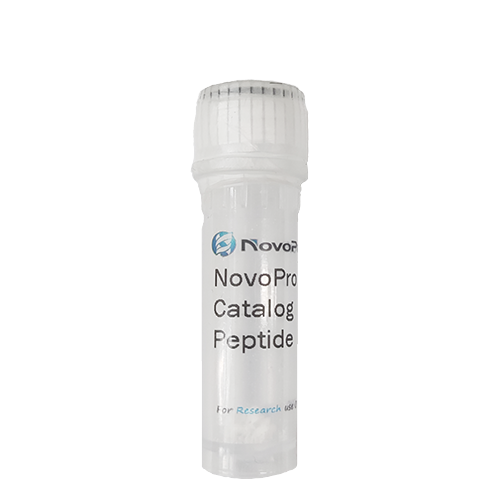
DcP5 (cyclic and D-form of P5 peptide)
Not For Human Use, Lab Use Only.
Cat.#: 319856
Special Price 198.30 USD
Availability:
5 working days
-
Product Name
DcP5 (cyclic and D-form of P5 peptide)
-
Documents
Batch to batch variation of the purity
-
Sequence Shortening
clqlqaeerc (C1-C10 cyclic, all D-amino acids)
-
Sequence
H-D-Cys(1)-D-Leu-D-Gln-D-Leu-D-Gln-D-Ala-D-Glu-D-Glu-D-Arg-D-Cys(1)-OH (C1-C10 cyclic)
-
Length (aa)
10
-
Peptide Purity (HPLC)
98.12%
-
Molecular Formula
C47H79N15O17S2
-
Molecular Weight
1190.35
-
Source
Synthetic
-
Form
Powder
-
Description
DcP5 is a cyclic peptide derivative developed from the linear epitope peptide P5, which originates from the FGF2 sequence (LQLQAEER, amino acids 53-60). The cyclization is achieved by incorporating D-cysteine residues at both ends to form a disulfide bond, enhancing structural stability. DcP5 exhibits high binding affinity to fibroblast growth factor receptor 2 (FGFR2), with a dissociation constant (KD) of 2.75 × 10⁻⁹ M, competitively inhibiting FGFR2 activation by obstructing FGF2 interaction. Key residues Gln4 and Glu6 in the peptide are critical for FGFR2 binding, and their substitution abolishes this activity.
The cyclic structure of DcP5 confers improved in vivo stability and prolonged half-life compared to the linear P5 peptide. It effectively suppresses downstream signaling pathways, including phosphorylation of AKT and ERK1/2, leading to reduced cellular proliferation in FGFR2-expressing systems. This peptide demonstrates specific FGFR2-dependent activity and serves as a targeted inhibitor for studying FGFR2-related signaling mechanisms.
-
Storage Guidelines
Normally, this peptide will be delivered in lyophilized form and should be stored in a freezer at or below -20 °C. For more details, please refer to the manual: Handling and Storage of Synthetic Peptides
-
References
- Zhang Y, Ouyang M, Wang H, Zhang B, Guang W, Liu R, Li X, Shih TC, Li Z, Cao J, Meng Q, Su Z, Ye J, Liu F, Hong A, Chen X. A cyclic peptide retards the proliferation of DU145 prostate cancer cells in vitro and in vivo through inhibition of FGFR2. MedComm (2020). 2020 Dec 14;1(3):362-375. doi: 10.1002/mco2.48. PMID: 34766128; PMCID: PMC8491194.
-
About TFA salt
Trifluoroacetic acid (TFA) is a common counterion from the purification process using High-Performance Liquid Chromatography (HPLC). The presence of TFA can affect the peptide's net weight, appearance, and solubility.
Impact on Net Weight: The TFA salt contributes to the total mass of the product. In most cases, the peptide content constitutes >80% of the total weight, with TFA accounting for the remainder.
Solubility: TFA salts generally enhance the solubility of peptides in aqueous solutions.
In Biological Assays: For most standard in vitro assays, the residual TFA levels do not cause interference. However, for highly sensitive cellular or biochemical studies, please be aware of its presence.
-
Molar Concentration Calculator
-
Dilution Calculator
-
Percent Concentration Calculator
Mass (g) = Concentration (mol/L) × Volume (L) × Molecular Weight (g/mol)
Related Products / Services
• Peptide Services: NovoPro's peptide synthesis services include standard chemical peptide synthesis, peptide modification, peptide libraries, and recombinant peptide expression.
• Standard Peptide Synthesis: NovoPro offers quality peptides at the most competitive prices in the industry, starting at $3.20 per amino acid. NovoPro provides PepBox – Automatic Quote Tool for online price calculation.
• Peptide Modifications: NovoPro offers a wide range of peptide modification services including isotope labeling (2H, 15N, and 13C), multiple disulfide bonds, multiple phosphorylations, KLH, BSA, ovalbumin, amidation, acetylation, biotin, FITC, etc.
Please note: All products are "FOR RESEARCH USE ONLY AND ARE NOT INTENDED FOR DIAGNOSTIC OR THERAPEUTIC USE"