Cysteinase proteinase inhibitor peptide
Not For Human Use, Lab Use Only.
Cat.#: 315515
Special Price 293.40 USD
Availability:
5 working days
-
Product Name
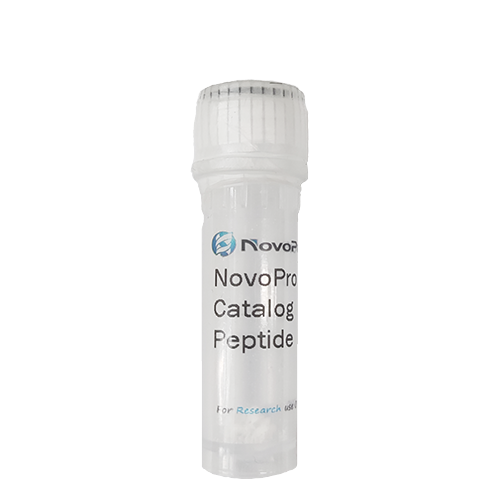
Cysteinase proteinase inhibitor peptide
-
Documents
Batch to batch variation of the purity
-
Sequence Shortening
IPGGLSEAKPATPEIQEIVDKVKPQLKEKT
-
Sequence
H-Ile-Pro-Gly-Gly-Leu-Ser-Glu-Ala-Lys-Pro-Ala-Thr-Pro-Glu-Ile-Gln-Glu-Ile-Val-Asp-Lys-Val-Lys-Pro-Gln-Leu-Lys-Glu-Lys-Thr-OH
-
Length (aa)
30
-
Peptide Purity (HPLC)
95.9%
-
Molecular Formula
C145H247N37O46
-
Molecular Weight
3244.7
-
Source
Synthetic
-
Form
Powder
-
Description
A cysteine proteinase inhibitor was identified in the culture media of Candida albicans. The purified inhibitor has a molecular weight of 15 kDa and an isoelectric point of 4.9. It exhibits high stability to heat and across a broad pH range. The N-terminal amino acid sequence of the first 30 residues shows significant similarity to human cystatin A, indicating that this inhibitor belongs to the cystatin superfamily. The inhibitor specifically inactivates cysteine proteinases such as papain and ficin, acting as a noncompetitive inhibitor.
The production of this inhibitor varies with the morphological state of C. albicans. The yeast cellular form demonstrates approximately 4.0 times higher inhibitory activity in 7-day culture media compared to the hyphal form. This differential expression suggests the inhibitor may have regulatory functions related to cellular morphology and proteinase activity within the organism.
-
Storage Guidelines
Normally, this peptide will be delivered in lyophilized form and should be stored in a freezer at or below -20 °C. For more details, please refer to the manual: Handling and Storage of Synthetic Peptides
-
References
- Tsushima H, Mine H, Hoshika K, Kawakami Y, Hyodoh F, Ueki A. Candida albicans produces a cystatin-type cysteine proteinase inhibitor. J Bacteriol. 1992 Jul;174(14):4807-10. doi: 10.1128/jb.174.14.4807-4810.1992. PMID: 1624467; PMCID: PMC206279.
-
About TFA salt
Trifluoroacetic acid (TFA) is a common counterion from the purification process using High-Performance Liquid Chromatography (HPLC). The presence of TFA can affect the peptide's net weight, appearance, and solubility.
Impact on Net Weight: The TFA salt contributes to the total mass of the product. In most cases, the peptide content constitutes >80% of the total weight, with TFA accounting for the remainder.
Solubility: TFA salts generally enhance the solubility of peptides in aqueous solutions.
In Biological Assays: For most standard in vitro assays, the residual TFA levels do not cause interference. However, for highly sensitive cellular or biochemical studies, please be aware of its presence.
-
Molar Concentration Calculator
-
Dilution Calculator
-
Percent Concentration Calculator
Mass (g) = Concentration (mol/L) × Volume (L) × Molecular Weight (g/mol)
Related Products / Services
• Peptide Services: NovoPro's peptide synthesis services include standard chemical peptide synthesis, peptide modification, peptide libraries, and recombinant peptide expression.
• Standard Peptide Synthesis: NovoPro offers quality peptides at the most competitive prices in the industry, starting at $3.20 per amino acid. NovoPro provides PepBox – Automatic Quote Tool for online price calculation.
• Peptide Modifications: NovoPro offers a wide range of peptide modification services including isotope labeling (2H, 15N, and 13C), multiple disulfide bonds, multiple phosphorylations, KLH, BSA, ovalbumin, amidation, acetylation, biotin, FITC, etc.
Please note: All products are "FOR RESEARCH USE ONLY AND ARE NOT INTENDED FOR DIAGNOSTIC OR THERAPEUTIC USE"