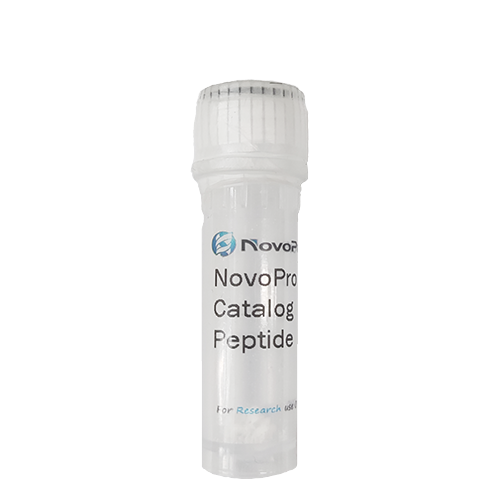
Brevinin-2LF1 peptide
Not For Human Use, Lab Use Only.
Cat.#: 300129
Special Price 527.40 USD
Availability:
4 weeks
-
Product Name
Brevinin-2LF1 peptide
-
Documents
Batch to batch variation of the purity
-
Sequence Shortening
H-GFMDTAKNVAKNVAKNVAVTLLDKLRCKVTGGC-OH
-
Sequence
H-Gly-Phe-Met-Asp-Thr-Ala-Lys-Asn-Val-Ala-Lys-Asn-Val-Ala-Lys-Asn-Val-Ala-Val-Thr-Leu-Leu-Asp-Lys-Leu-Arg-Cys-Lys-Val-Thr-Gly-Gly-Cys-OH (disulfide bond: Cys27-Cys33)
-
Length (aa)
33
-
Peptide Purity (HPLC)
97%
-
Molecular Formula
C149H256N44O44S3
-
Molecular Weight
3464.15
-
Source
Synthetic
-
Form
Powder
-
Description
Brevinin-2LF1 is a cationic antimicrobial peptide identified from the skin secretions of Amolops lifanensis, an East Asian frog species. This peptide contains 33 amino acid residues with a net charge of +4 at pH 7 and a theoretical pI of 10.70. Its observed molecular mass is 3464.08 Da, consistent with the calculated mass of 3464.14 Da. The peptide features two cysteine residues capable of forming a single intramolecular disulfide bond, a structural characteristic common to many amphibian antimicrobial peptides. Brevinin-2LF1 exhibits antimicrobial activity against a range of microorganisms. It demonstrates high potency against the Gram-negative bacterium Psychrobacter faecalis X29, with a minimum inhibitory concentration (MIC) of 3.1 mM, and also shows activity against Gram-positive bacteria such as Staphylococcus aureus and Nocardia asteroides. The peptide shares a precursor structure similar to other antimicrobial and antioxidant peptides from ranid frogs, consisting of a signal peptide and an N-terminal acidic spacer domain terminated by a dibasic processing site.
-
Storage Guidelines
Normally, this peptide will be delivered in lyophilized form and should be stored in a freezer at or below -20 °C. For more details, please refer to the manual: Handling and Storage of Synthetic Peptides
-
References
- Guo C, Hu Y, Li J, et al. Identification of multiple peptides with antioxidant and antimicrobial activities from skin and its secretions of Hylarana taipehensis, Amolops lifanensis, and Amolops granulosus. Biochimie. 2014;105:192-201.
-
About TFA salt
Trifluoroacetic acid (TFA) is a common counterion from the purification process using High-Performance Liquid Chromatography (HPLC). The presence of TFA can affect the peptide's net weight, appearance, and solubility.
Impact on Net Weight: The TFA salt contributes to the total mass of the product. In most cases, the peptide content constitutes >80% of the total weight, with TFA accounting for the remainder.
Solubility: TFA salts generally enhance the solubility of peptides in aqueous solutions.
In Biological Assays: For most standard in vitro assays, the residual TFA levels do not cause interference. However, for highly sensitive cellular or biochemical studies, please be aware of its presence.
-
Molar Concentration Calculator
-
Dilution Calculator
-
Percent Concentration Calculator
Mass (g) = Concentration (mol/L) × Volume (L) × Molecular Weight (g/mol)
Related Products / Services
• Peptide Services: NovoPro's peptide synthesis services include standard chemical peptide synthesis, peptide modification, peptide libraries, and recombinant peptide expression.
• Standard Peptide Synthesis: NovoPro offers quality peptides at the most competitive prices in the industry, starting at $3.20 per amino acid. NovoPro provides PepBox – Automatic Quote Tool for online price calculation.
• Peptide Modifications: NovoPro offers a wide range of peptide modification services including isotope labeling (2H, 15N, and 13C), multiple disulfide bonds, multiple phosphorylations, KLH, BSA, ovalbumin, amidation, acetylation, biotin, FITC, etc.
Please note: All products are "FOR RESEARCH USE ONLY AND ARE NOT INTENDED FOR DIAGNOSTIC OR THERAPEUTIC USE"